










University of Exeter Press
Nonhuman Cinema
Couldn't load pickup availability
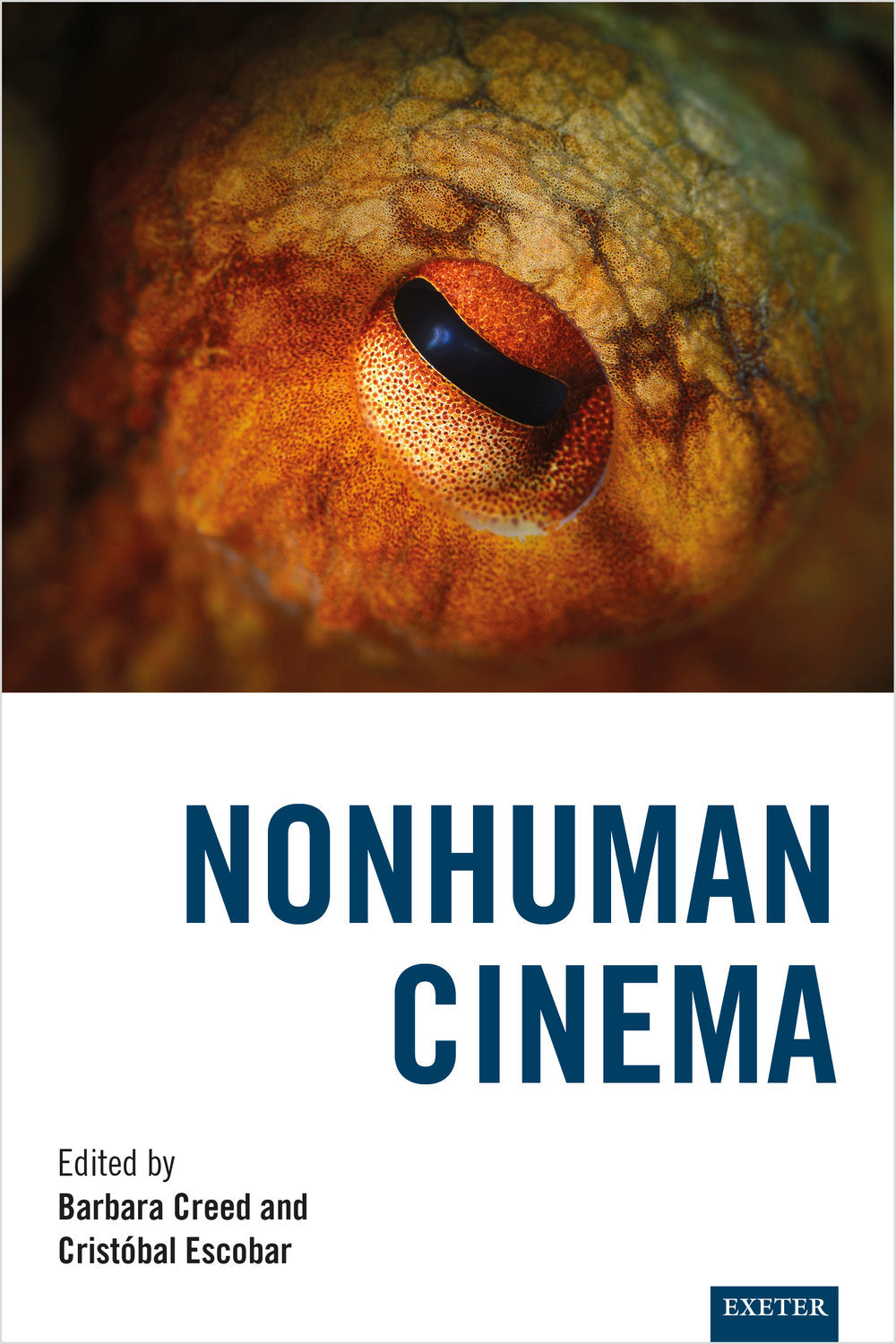


In an era defined by environmental crisis, artificial intelligence, and multispecies interdependence, what happens if we continue to ignore crucial nonhuman relationships that weigh so significantly on the future of the planet? Nonhuman Cinema explores how film can destabilize anthropocentrism and help us see and think beyond the human. In doing so, it defines what a nonhuman cinema might look like—its parameters, major characteristics, goals, and significance.
Bringing together leading scholars and filmmakers, this book introduces a new framework for understanding film as a site of entanglement between humans, animals, aliens, ecosystems, cyborgs, machines, galaxies and the natural world. It examines how films can decentre the human gaze, disrupt anthropocentric narratives, undermine ontological categories, and immerse viewers in unfamiliar territories, temporalities and sensoria. Importantly, it also asks what happens when cinema itself becomes nonhuman: when the camera is no longer viewed as an instrument of human vision but as a participant in the world’s material and sensory life.
Written and edited by individuals at the forefront of film and media theory, Nonhuman Cinema offers an original and vital intervention in contemporary thought. It will appeal to readers interested in film studies, media, philosophy, new materialism, environmental humanities, feminism, queer theory, art history, and to anyone curious about how cinema can help us rethink what ‘human’ really means in the twenty-first century.
Essential reading for film scholars and students interested in posthumanism; a timely and vital update to the field. Barbara Creed and Cristóbal Escobar’s new edited volume is rigorously edited and a pleasure to read, providing a comprehensive survey of nonhuman categories (everything from mountains to monsters to machines) across cinematic modes. Nonhuman Cinema is the rare volume that is at once theoretically sophisticated enough for advanced researchers and accessible enough to assign to undergraduates.
Chelsea Birks, author of Limit Cinema: Transgression and the Nonhuman in Contemporary Global Film
Preface: Notes Towards a Nonhuman Cinema
Barbara Creed and Cristóbal Escobar
DOI: 10.47788/UMHT9141
Introduction: New Approaches to Film and the Nonhuman
Barbara Creed and Cristóbal Escobar
DOI: 10.47788/YMUV7341
1. More-than-Human Visualities in Recent Palestinian Film and Video
Anat Pick
DOI: 10.47788/KNWB7253
2. The Sensuous Appeal of Mountains in Film
Vincent Deville
DOI: 10.47788/IXHX1482
3. Screening Nature: Landscape and Ecocentrism in the Films of Michael Snow and James Benning
Jelena Mišeljić
DOI: 10.47788/AQDV1742
4. Night Skies: Stargazing as Proto-Cinema
Seán Cubitt
DOI: 10.47788/CRHB1110
5. A Silent Anarchist Bestiary in Early Cinema
Alice Leroy
DOI: 10.47788/EUAS4789
6. Space, Time and Agency: Non/Human Entanglements in Alex Garland’s Annihilation
Zina Giannopoulou
DOI: 10.47788/TXGT8717
7. Valdimar Jóhannsson’s Lamb and the Impure Ontologies Inhabiting the Anthropocene
Luis Barboza
DOI: 10.47788/YLOT8534
8. Displacement on the Butcher’s Block
Desmond Bellamy
DOI: 10.47788/DVXP7606
9. Part of the Feast: NBC’s Hannibal and Val Plumwood’s Food-Based Approach to Death
Ivana Brehas
DOI: 10.47788/ASWI7999
10. Stray Ethics and Queer Becomings: My Octopus Teacher
Barbara Creed
DOI: 10.47788/KMWQ7631
11. (Trans)ending the Body: Queering Fatherhood in Julia Ducournau’s Titane
Iliana Cuellar
DOI: 10.47788/CNQY6706
12. Fuse Box: How the Television Set Interlaces Queer Bodies in Horror Cinema
Claire Henry
DOI: 10.47788/TXMF2860
13. Skin and Shadows: Spirited Materialism in Liang Luscombe’s Evocation of the Ghostly Feminine
Tessa Laird
DOI: 10.47788/AMBN9441
14. Films to Make a World of Many Worlds: Sensoriality, Wonder and Gaps of Knowledge to Show the Pluriverse
Clara Kleininger-Wanik
DOI: 10.47788/IDRA2549
15. Exteriority and Ambiguity: On Pedro Costa’s Cavalo dinheiro and Vitalina Varela
Reinhold Görling
DOI: 10.47788/IUPP6149